

Pick Up Your Pencils, Begin is about the impact of standardized test on our educational system.
Our current educational system continues to teach students based on a rigid model, largely unchanged from the last 100 years. This is despite our understanding about different learning styles. Every student is required to learn in the same way and from the same text books, conforming to a expectation of identical performance standards.
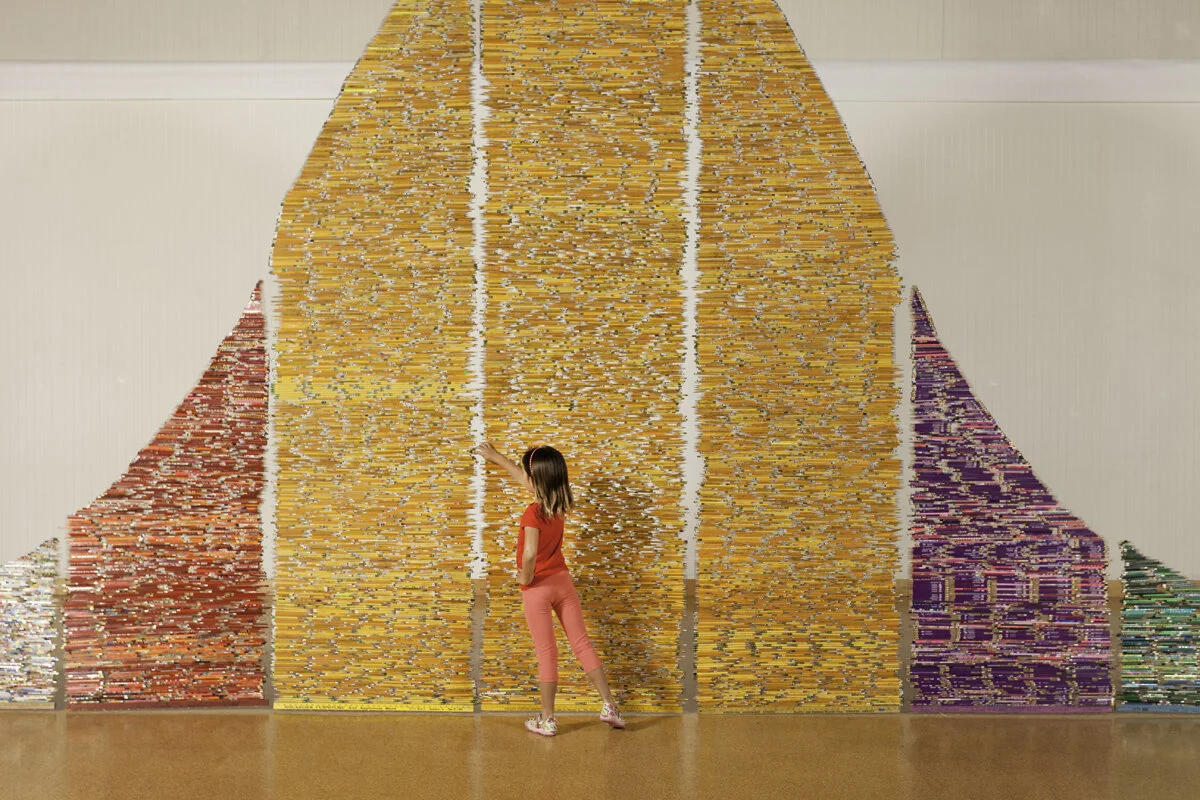
Student performance is then measured on a bell curve. Since the tests are nationally normed for average performance, most students are supposed to fit into the center three stanines of the bell curve.
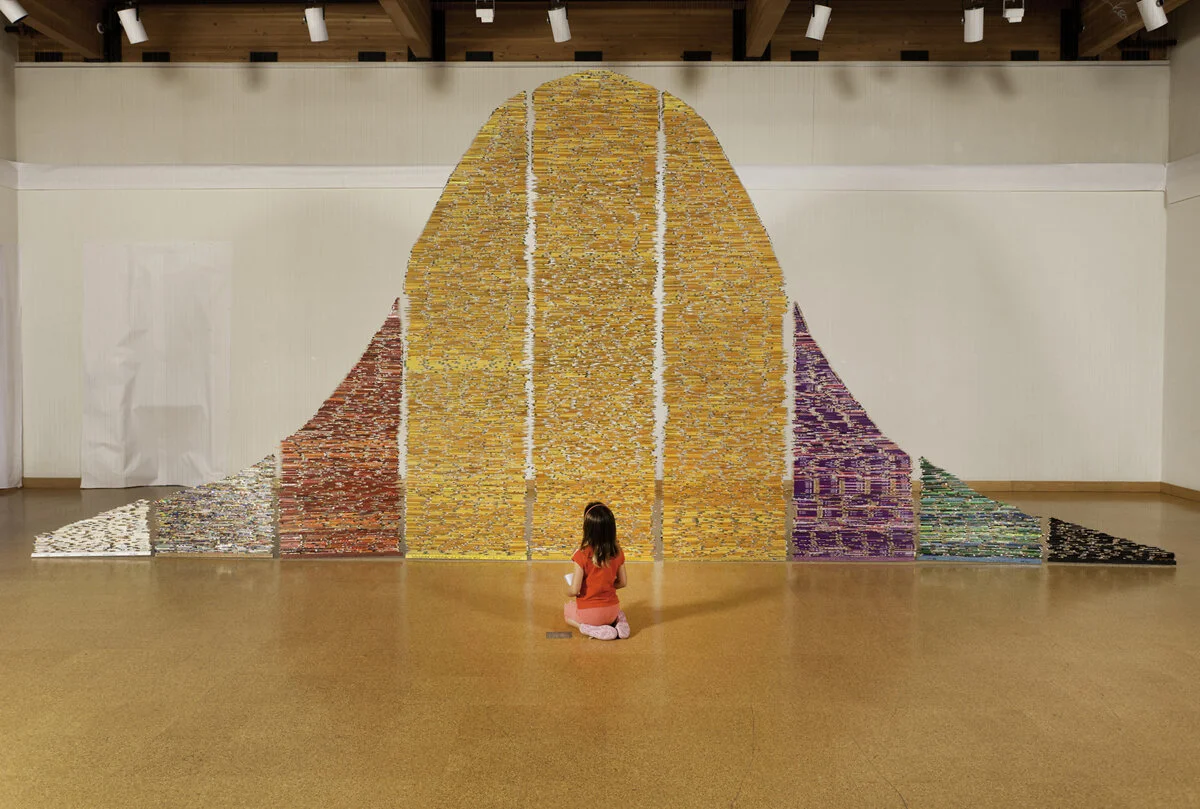


The bell curve is constructed from pencils. It is a sculpture 28 ft. wide and 12 ft. height that hangs from the center of the room like a curtain or barrier. It is a symbol of the focus on standardized testing in our educational system. As we become more desperate to evaluate the effectiveness of our educational system, we implement testing standards that are nationally normed for measuring the average student.
This issue has recently revived during the pandemic.
Click on links below to find images and information:
Visiting schools and working with the public assembling pencils
Videos about education and the impact of standardized testing

Pick Up Your Pencils, Begin won FIRST PLACE in the Eco Arts Awards for "Repurposed Materials in Art and Design".
The category title was suggested by the juror Lloyd Herman.
Thousands of #2 pencils form an ephemeral curtain that moves with the slightest breath of air. This installation emphasizes material reuse, student education, math, science, and diversity.
Pencils were sent to me from around the world, uniting a community of artists, students, and educators. This installation represents my continuing commitment to make artwork from recycled materials addressing social issues.
"As the number of government-mandated tests multiplies, anger is mounting over wasted school hours, 'testing to the test,' a shrinking focus on the arts, demoralized students, and perceptions that teachers are being unjustly blamed for deeply-rooted socio-economic problems."
This quote from the article "Pencils Down" from YES Magazine, Spring 2014, summarizes my observations and frustration as a parent.
Shipping Art Installation
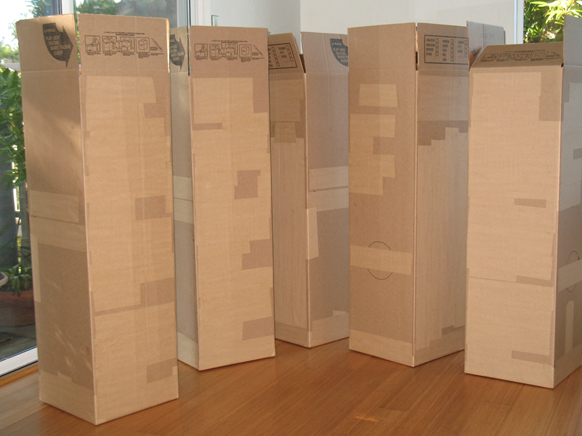
Pick Up Your Pencils, Begin ships in five boxes.
Dimension for these interior shipping boxes: 40"H x 12"W x 12"D.
Weight for the boxes: 26 lbs., 30 lbs., 26 lbs., 25 lbs., and 23 lbs.
Local delivery - I can ship the work in these boxes.
Long distance shipping - I will double box the art work in larger shipping boxes.
Installation and De-installation of the Pencil Art takes 4 hours for each process
Pick Up Your Pencils, Begin - Installation Equipment and Details
De-installation
De-Installation (Behind the Scene) Rolling Up the Artwork
Past Exhibition Installation Images

This art installation of pencils hangs like a shimmering curtain presenting a broad face to the world, yet if you stand at the edge, it is only the ethereal thickness of a pencil. The monofilament warp reaches to the ceiling as if it were the lines of a graph. Shown hanging Anita Seipp Gallery, Castilleja School
Model: Aryn Shelander Photo Credit: Deborah Trilling
The assembly was like a woven tapestry of pencils. The mono-filament fishing line was the warp. The pencils were the weft. This created an abstract zigzag pattern.

Pick UP Your Pencils, Begin at Euphrat Museum of Art, DeAnza College, Cupertino, CA
Magazine Articles & Publicity

Photo credit: Philip Cohen
This image was in American Craft Magazine Dec/Jan 2012, (click to read the article as a PDF) a fabulous article by editor, Julie K. Hanus!
Quoting from the article: "Pick Up Your Pencils, Begin is a 12-foot-tall, 28-foot-wide shimmering curtain of pencils, hanging in the shape of a bell curve - the statistical "normal distribution" used to design standardized tests."

Palo Alto Weekly March23, 2012
"Artist Makes a Point with Pencils"
Article writer is Karla Kane; Editor is Rebecca Wallace; and the photographer is Veronica Weber.
Student Responses to Pencil Art Exhibition

Student responses to this art installation include drawings, poetry and photography.
Click HERE to view all these efforts on another page dedicated to their creativity.
Math classes came to study the bell curve as a mathematical model. Indeed, art can teach mathematical concepts.
Pencil Symposium: A discussion with San Francisco Bay Area high school students about the impact of standardized testing and their most effective educational experience was video taped on Thursday, March 15, 2012.
This was edited into a short video shown below.

Funding for videotaping the PENCIL SYMPOSIUM and the EOP provided by Applied Materials Excellence in the Arts Grants, a program of Arts Council of Silicon Valley.
Visiting Schools - Working with Students


During the assembly which took years, I went to schools lectured about my work and the students worked on the pencil project.
Interesting in concept, asking people to work on your art project is not easy. The implementation was a difficult reality. More than once I had to come home and fix the pencils the students or the public assembled.
Students at Academy of Art, San Francisco, volunteered their time to work on the project. They learned how to thread the pencils onto the monofilament.
It is easy to see that we are at the beginning stages of the project. Working with the public, even with talented art students is very slow in the first hour or two until they build experience.


Art students at Sequoia High School were REALLY great helping with the pencils, spending several hours on a Sunday helping assemble the pencils.
They did a fantastic job catching on quickly to the precise way the pencils needed to be threaded onto the mono-filament fishing line.
My experience working with students, adults, the general public, and art teachers was uncanny and unpredictable.
Some people grasped the concept of assembly and learned how to thread the pencils immediately, others never quite got it right. Age had nothing to do with it. Some people are born to work with their hands.
The Five Year Assembly Process

This graphic is the model drawing for the bell curve of pencils. Each color represents a panel of pencils. The bell curve is mathematical model divided into nine parts called stanines. The bell curve is how student performance on standardized tests is evaluated.
Below is an actual ACT Assessment Student Report. The name of the student has been obscured for confidentiality.
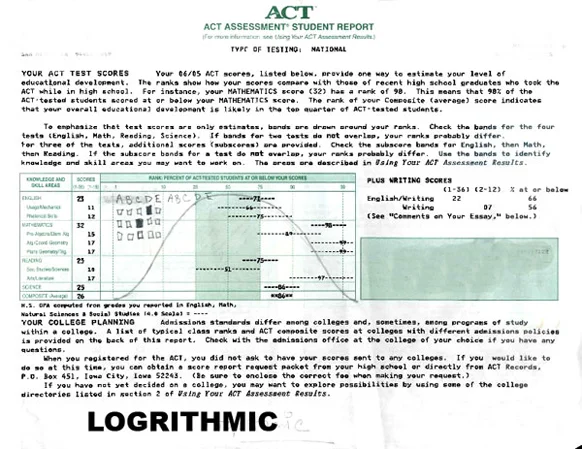
In these test results, the numbers reflect the bell curve in a nationally normed test where student performance is measured against all other students. (I drew the bell curve in pencil so that you would understand how students performance is measured on standardized tests.)
Standardized tests reflect an increasing influence and power of corporations that have a huge investment in mandating testing. "The Federal government spends some $600 billion a year on education" - and the big business of education profits from a selling text books, curriculum and standardized tests. This is all a formula for rote learning and marginalization of the arts in education. Critical thinking, creativity, and problem solving - all skills of the 21st century are difficult to evaluate with fill in the bubble testing. *Quote from the article "Pencils Down" from YES Magazine, Spring 2014.
What do the different colors of pencils mean?
This sculpture made from pencils is about standardized testing in the shape of a bell curve. The bell curve is approximately 12 feet high and 28 feet wide.

Photo credit: Philip Cohen

Photo credit: Aryn Shelander
Standard #2 yellow pencils will be used for the center three yellow stanines.
The yellow #2 pencils represent the nationally normed standardized test where most of all students are supposed to fit into the center of the bell curve. This is why the bell curve humps up in the middle.

Photo Credit: Philip Cohen
Students that deviate from the norm are the colored stanines on either side using white, multi-colored, red, purple, blue/green and black pencils #2 pencils with a colored exterior.
The colors represents the diversity of the student population. On standardized testing it would reflect both high and low performance.
The young fellow in this photo is Adam Evans. He was responsible for drilling most of the pencils.

Photo Credit: Philip Cohen
The red pencils (left) are #2 pencils with a red exterior.
The impact of standardized testing on our educational system is enormous. There is a huge financial investment resulting in a tremendous impact on the students, teachers, school districts, and the content of the curriculum.
Standardized tests only evaluate a small spectrum of student ability, excluding the arts, athletic and theatrical performance, creativity, and more.
The arts teach creativity and problem solving, two skills needed in the 21st century, but they are increasingly marginalized by a curriculum based on performance standards.
Where did you get all the pencils from?

The pencils were sent to me from all over the world. Pencils came from Japan, France, Britain, Italy, but most were from the United States.
For over a year, I send out a PDF by email and mail, to everyone I knew. The goal was to collect used pencils. Pencils that people used to take standardized tests.
Gradually word spread. School children, teachers, classrooms, entire school, friends, and families collected pencils for this project.
Students and teachers sent pencils as a commentary about the focus on standardized testing and the impact on education.
When was the first public event with this project?
The assembly of pencil project was officially started at the annual conference for the California Art Education Association "Art Bridges the Gap" at the Hyatt Hotel in Burlingame in 2008. (I had been co, mostly art teachers, started to assemble the pencils in stanines of colored pencils.) Right in the mail conference lobby, we worked for three days drilling pencils, measuring monofilament fishing line, and beginning the assembly process.
I also lectured for the Conference as a keynote speaker. The audience loved it!
I received a standing ovation for my lecture!!!! I am not kidding....the first time ever ....a standing ovation from the entire audience.

How did you know if you had enough pencils?
In the beginning I sorted the pencils by color and weighed each bag. I had an idea how much a square foot of pencils would weigh. One square foot of pencils = about 12 ounces.
By weight it looked like I have enough pencils. My fingers were crossed that I have enough for the whole sculpture.

I had more than 300 lbs of used pencils, but my rough calculations worked out.....with only a small quantity of pencils left over.
Listen to a great video lecture by Sir Ken Robinson about how our current educational system is undermining creativity? It is worth your time.
How did you get the holes in the pencils?
The holes in the pencils were drilled with a very small micro-drill which my son modified for this project.
He also created a jig so that the pencils have small holes drilled exactly the same way; each hole is exactly the same distance apart.

Here I am drilling pencils. Look over my shoulder a little more closely. The pencils sit is a piece of aluminum, milled to hold the pencils in a row.
Drilling the pencils is the most time consuming and tedious part of this project. The graphite from the pencils is not "dusty", but it makes a mess. Each hole needs to be drilled very carefully so that the printing and words on the pencils will show in the final sculpture. I hired art students to drill most of the pencils. Thank you Adam Evan, Adam Klafter and Alyssa Endo.
As simple as this project looked, it actually took two engineers (my husband and son) and me hours to brainstorm all the technical solutions for putting the pencils together. Keep reading for more fabrication images.
How did you begin threading the pencils?

The beginning was the most challenging. We taped down yardsticks to the paper and started threading the pencils. We were slow, made mistakes and learned the hard way with experience.
After we started threading the pencils, we realized that the metal ferrule holding on the eraser would start skewing the thickness and balance of the pencils. This is why the pencils change direction every foot.
Shown in this animated GIF is artist Harriete Estel Berman (left) and studio assistant Emiko Oye (right.) November 2008
Did you sharpen the pencils?
For a long time we used a pencil sharpener to sharpen each pencil before drilling. Then I got smart, and started sharpening pencils in bulk using my belt sander this was much faster.

I thought that the pencils should be sharpened for the art installation because test takers are instructed to bring two #2 pencils for taking a standardized test.
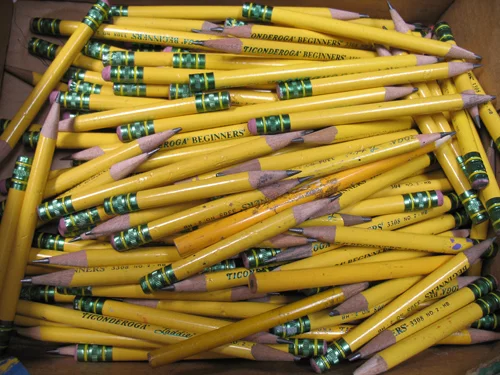
Beginner pencils were included in the art installation because standardized testing starts in Kindergarten.
By 3rd grade all students in California take standardized tests.
Cathy Tapia commented:
"I love your concept!! As a preschool teacher I am appalled that I am now REQUIRED to test my 3 and 4 year old students to PROVE their progress. I have worn out many pencils filling in the bubble sheets for the state of Michigan. I love that you included the kindergarten pencils."
How were the pencils threaded together?

Monofilament fishing line had to be threaded thought the holes in each pencil. Threading pencils on the fishing line must be done very precisely, but it is the easiest part of the assembly process. A skilled hand could do one row of pencils in about five minutes.
Summer 2010: I hired a college art student, Alyssa Endo, to help me work on this project. After so many years of slow progress with students working on the installation it was going to slowly. I just needed to get it done. Taking the pencils to Maker Faire and schools for students to work on was fun, but not productive, very very slow....too slow.

With Alyssa's help progress was much faster.
How did you get the curves of the bell curve to match up?

Emiko Oye, my studio assistant (and friend) helped me work on the top edge of the stanines. (She is wearing a knit cap and sweatshirts because my house is so cold.)
I had to move all the furniture in my living room to make room for the final adjustment of this sculpture. (You can see artwork normally on display pushed to the side.)
It took a great deal of skill, practice, trial and error to get the curve of pencils to line up.
Why did you attach rulers to the bottom of each stanine
I am using yardsticks to give the pencil sculpture a firm, straight flat bottom. Look closely at the photos of the finished sculpture. The yardsticks nudge the floor.
The yardsticks are a metaphor for measuring the students and the fact that students used to be hit by yardsticks and rulers to conform to expectations.

Photo Credit: Philip Cohen
The yardsticks are a metaphor for the performance standards used to measure students, teachers and schools, along with academic performance.
Can you share more images of special pencils?
Pencils can be very special. At one time pencils were a vehicle for advertising.

Below is an image of pencils from the Pencil Brothers. They were two men, Ken Cory and Leslie W. LePere, that collaborated for years (approximately 1966-1986) making jewelry and small objects. They were best known in the Seattle and Pacific Northwest area of the United States.
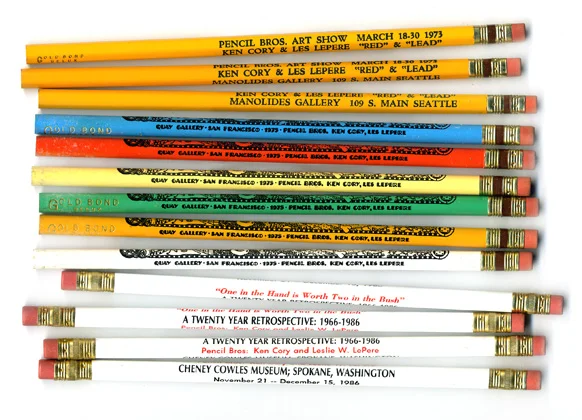
I was very fortunate to be given a number of pencils from the Pencil Brothers from past exhibitions to include in Pick Up Your Pencils, Begin. These pencils are from exhibitions at Quay Gallery, San Francisco, CA.; Manolides Gallery, Seattle, WA and a retrospective of their work at the Cheney Cowles Museum, Spokane, WA. Pencil Brothers: Ken Cory, born Kirkland, Washington, 1943; Died Ellensburg, Washington, 1994 Leslie LePere, born Spokane, Washington, 1946 The pencils were donated by Nancy Worden executor of Ken Cory estate.
Below is a close-up view of pencils from the Pencil Brothers (Ken Cory and Lepere) woven into the left center stanine.

These pencils from a 1990 census were used in the black stanine of pencils.

Here are the pencils used in the black stanine of pencils.
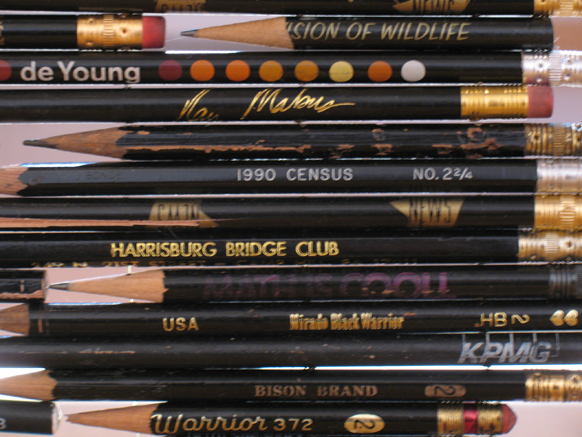
Pencils used to write and draw as a tool, also convey information. Looking at old pencils we realize that they are an iconic tool of the 20th century. Everyone used pencils. They were inexpensive, easy to carry, and did not leak ink. Before the disposal pen, everyone used pencils, every day. Because of their ubiquity, they were also used as an effective marketing tool for advertising sharing information.
Videos about Education and Standardized Testing
Wonderful video with Sir Ken Robinson as he addresses "Do schools kill creativity?" Definitely worth watching.
As you listen to this video ask yourself, "Why are our educational systems investing millions of dollars in standardized testing instead of the arts?”
The arts teach creativity and problem solving skills of the 21st century, but education continues to focus on "back to basics" and quantifiable education that can be measured with standardized tests.
Ken Robinson says:
"When you travel around the world, every education system on earth has the same hierarchy of subjects. Everyone does matter where you go. You’d think it will be otherwise but it isn't."
"At the top are mathematics and languages, than the humanities, and at the bottom are the arts. Every where on earth. And pretty much every system too, there's a hierarchy with in the arts. Art and music are normally given the higher status in schools than drama and dance."
In this video with Seth Godin describes the invention and purpose of the standardized test and how this continues to impact education with the factory model.
I originally became aware of the impact of standardized testing when my children were in school, and the Bush administration pushed "No Child Left Behind." There is a lot to say about this....but let's focus on the astute observations in this lecture with Ken Robinson. He says,
"Education under No Child Left Behind is based on not diversity, but conformity. What schools are encouraged to do is find out what kids can do across a very narrow spectrum achievement."
"One of the effects of No Child Left Behind has been to narrow the focus on to the so-called standard disciplines they are very important. I'm not here to argue against science and math, on the country, they are necessary but not sufficient. A real education has to give equal weight to the arts, the humanities, to physical education."
Quoting from the above video by Caleb Zakarin:
"The time, energy, and money that are being devoted to preparing students for standardized tests has to come from somewhere. Schools across the country are cutting back or even eliminating programs in the arts, recess for young children, electives for high school students, class meetings and other activities intended to promote social more learning and discussions about current events since some material will not appear on the test."
© Harriete Estel Berman, 2021